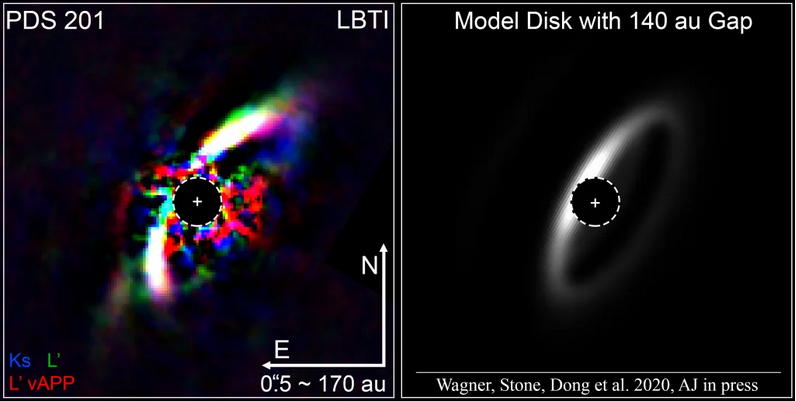
Protoplanetary disks offer an opportunity to learn about the processes by which planetary systems form and evolve. Images of these young systems also enable us to study, by analogy, the formation of our own Solar System, in which the common orbital plane of the...
The key goal of EOS is to advance our understanding of the formation of habitable planets. As an unusually large and ambitious program, EOS is in a rare position to successfully integrate interdisciplinary knowledge on planet formation – that is, to combine...
The Origins Seminar now has its own YouTube channel and the most recent talks are now available! Origins will continue to operate through most of the Summer and talks will be recorded and available through the Origins Seminar YouTube channel.
Renu Malhotra – LPL Professor and EOS Team Member – has recently given an excellent TEDx talk on the Search for Planet 9. The talk is now available online – check it...
Atmospheric characterization of transiting exoplanets Previous posts on this blog have discussed different methods for detecting exoplanets, including my favorite, the transit method. Transiting exoplanets, which pass directly in front of their host stars as seen from...
There are many ways astronomers have developed to detect exoplanets. Mikayla Mace introduced the most popular methods—radial velocity, transit, and direct imaging—in an earlier post on this blog. Each of these has their own strengths, making them useful for detecting...